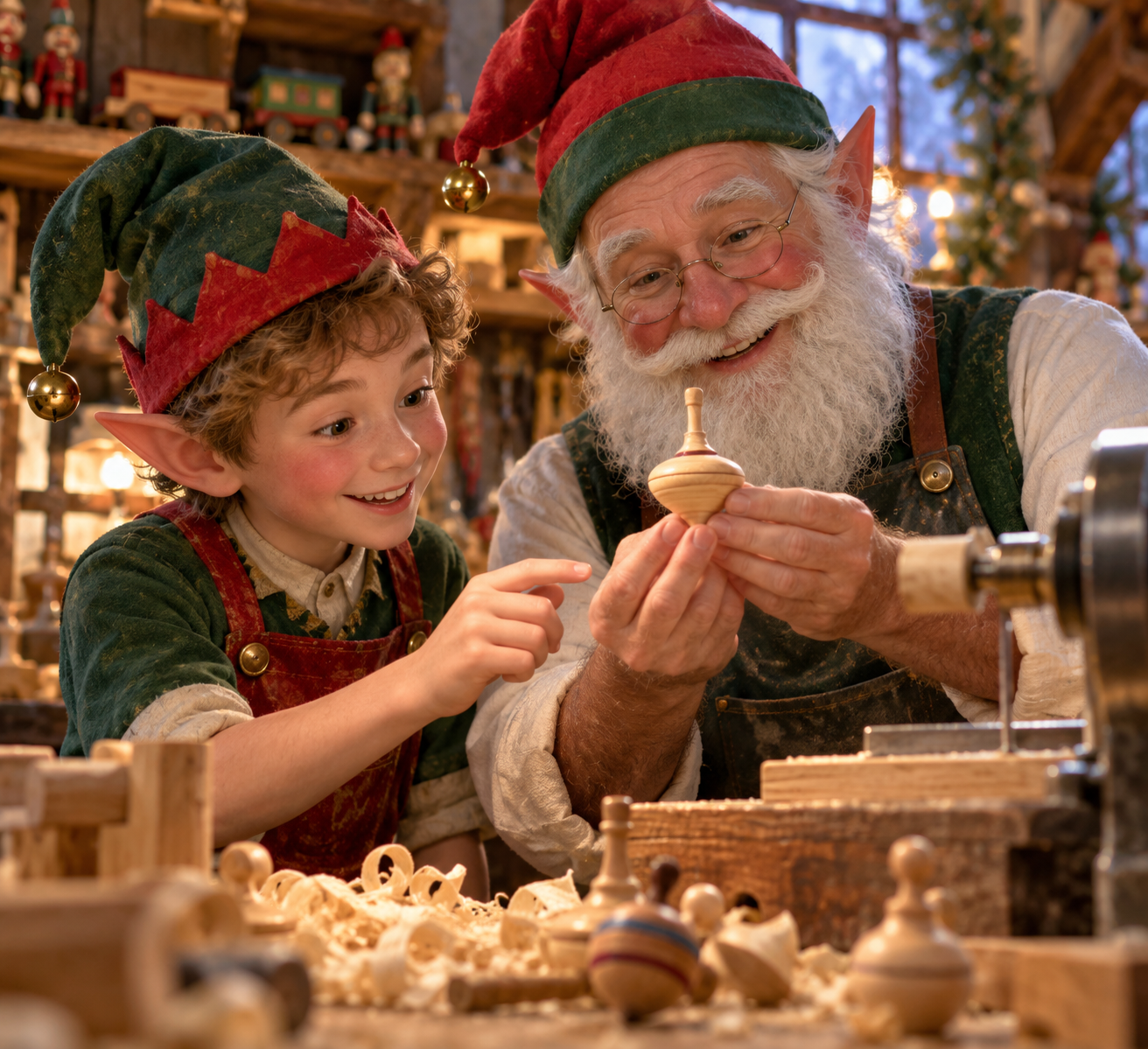
Now, most people imagine the North Pole Toy Shop as one enormous workshop. But it isn’t. There are dozens of little workshops tucked here and there – each filled with elves who have spent many, many Christmases learning their craft. There are painters and seamstresses, clockmakers and toy builders. And at the end of one long hallway is a workshop that I especially love. The North Pole Woodshop. You can usually tell when you’re getting close.
First comes the tap-tap-tap of wooden mallets. Then the soft scritch-scritch of sandpaper. And finally, you hear the wonderful humming of the woodturning lathes. The whole shop smells of maple, cherry, walnut and pine. Curly ribbons of wood cover the floor, and nearly every elf has a wood shaving caught somewhere in their apron or hat.
The oldest woodturner in the shop is an elf named Elias. Elias has been turning wood for so many Christmases that even I have stopped counting. He makes wheels for wooden trains, little bowls and cups, handles and knobs, Christmas ornaments, and the most marvelous spinning tops you’ve ever seen. And Elias has a rather unusual habit. Whenever the other elves finish a project, they put the little leftover pieces of wood into a box beside Elias’s workbench.
One morning, a young apprentice named Pip was helping him tidy the shop. Pip picked up the box. “I’ll empty the scrap box for you, Master Elias.” Elias looked over his spectacles. “The what?” “The scrap box.” Elias shook his head. “We don’t have a scrap box.” Pip looked down at the box in his hands. “Well … what is this?” Elias smiled. “Those are possibilities.”
“Possibilities?” “Indeed. Just because we don’t know what something can become doesn’t mean it can’t become something wonderful.”
Well, Pip wasn’t entirely convinced — especially when Elias reached into the box and pulled out a rather plain little piece of maple. “What could you possibly make from that?” Elias turned it over in his hand. “I don’t know yet.” And that was another thing Elias often said. A good woodturner, he believed, didn’t always begin by telling the wood what it was going to become. Sometimes he looked carefully at the grain, felt the wood in his hands, and let the answer come slowly.
So Elias placed that little piece of maple on his lathe. The lathe began to hum. Slowly, carefully, Elias worked. Tiny curls of maple floated down onto his apron. Pip watched as the little piece became smooth and round. Before long, Elias stopped the lathe. In his hand was a small wooden spinning top.
Pip frowned. “A top?” “A top,” said Elias. “But we have hundreds of tops.” “Not this one.” Elias sanded it until it was wonderfully smooth. Then, instead of sending it to the painting room, he rubbed in a little finish so the beautiful grain of the maple could still be seen. It was simple. No bright paint. No glitter. No fancy decorations. Just a little wooden top. On Christmas Eve, Elias brought it to me. “Santa,” he said, “I think this belongs to someone.” “Who?” “I don’t know.”
That wasn’t terribly helpful. But I put it into my sack anyway. And sometime after midnight, I came to a small house where two children lived – a little girl named Annie and her younger brother, Ben. Their tree was covered with homemade decorations. Paper chains, little drawings, and ornaments the children had made themselves. Beside the tree were two notes.
Ben’s was easy. He had drawn a very large picture of a fire truck. Underneath, in enormous letters, he had written: PLEASE. I chuckled. But Annie’s note was different. She hadn’t asked for anything for herself. She had written: Dear Santa, My little brother is still learning how to do things. Sometimes he gets frustrated when he can’t do what I can do. Could you bring him something we could learn to do together? I’ll help him.
I read that note twice. Then I thought of Elias. And his little wooden top. So I placed it beneath the tree. Christmas morning, Ben found it. At first he wasn’t quite sure what to do with it. Annie showed him. She gave it a twist. The little top danced across the floor. Ben’s eyes grew wide. “My turn!” His first try didn’t work. Neither did his second. Or his third. But Annie stayed beside him. “Try again,” she said. So he did. Again and again. Until finally … the little maple top began to spin. Ben squealed with delight. “I DID IT!” And Annie clapped louder than anyone.
Then something happened that even Santa hadn’t expected. Ben picked up the top and held it out to his sister. “Now you,” he said. And the two of them sat together on the floor, taking turns, laughing every time that little top wobbled, danced, and finally toppled over. Later that morning, their mother found them still playing together. There were other presents waiting beneath the tree. But for the moment, neither Ben nor Annie seemed interested in opening them. They were much too busy with one little wooden top.
When I returned to the North Pole, I went straight to the Woodshop. “Well?” Elias asked. I told him everything. Pip had been listening from across the room. He looked at the box beneath Elias’s workbench. Then he reached inside and picked up another little piece of wood. He turned it over carefully in his hands. “Master Elias?” “Yes, Pip?” “I think I found another possibility.” Elias smiled. “I rather thought you might.”
And from that Christmas on, no one in the North Pole Woodshop ever called those little pieces of wood scraps again. Because Elias had taught them something important. A woodturner can look at a simple piece of wood and see what the rest of us cannot see yet. A little bowl. A toy. An ornament. A spinning top. A gift waiting for the right pair of hands.
And perhaps people are a little like that, too.
Sometimes the smallest thing we do for someone – a little patience, a little encouragement, a helping hand – may not seem very important at the time. But to the person who receives it, it can mean everything.
So that Christmas, in a little house beneath the glow of a Christmas tree, there was more joy than presents could ever bring: a brother’s proud smile, a sister’s patient heart, and a little wooden top made from a piece of maple that someone else might have thrown away. And that, my friends, is something the elves in our North Pole Woodshop have never forgotten. The truest gifts aren’t always tucked beneath ribbons or wrapped in paper. Sometimes they begin as nothing more than a possibility. Then someone takes the time to notice. Someone takes the time to care.
And loving hands turn something small into something worth keeping. Perhaps that’s the real magic of making something with your own hands. Long after the wood shavings have been swept away and the tools have been put back on the shelf, what you made may still be sitting in someone’s home – and every time they pick it up, they remember.
Someone made this for me. And whenever someone knows they were worth another person’s time, patience, and care – well, the whole world feels just a little more like Christmas.
© 2021 Santa Paul